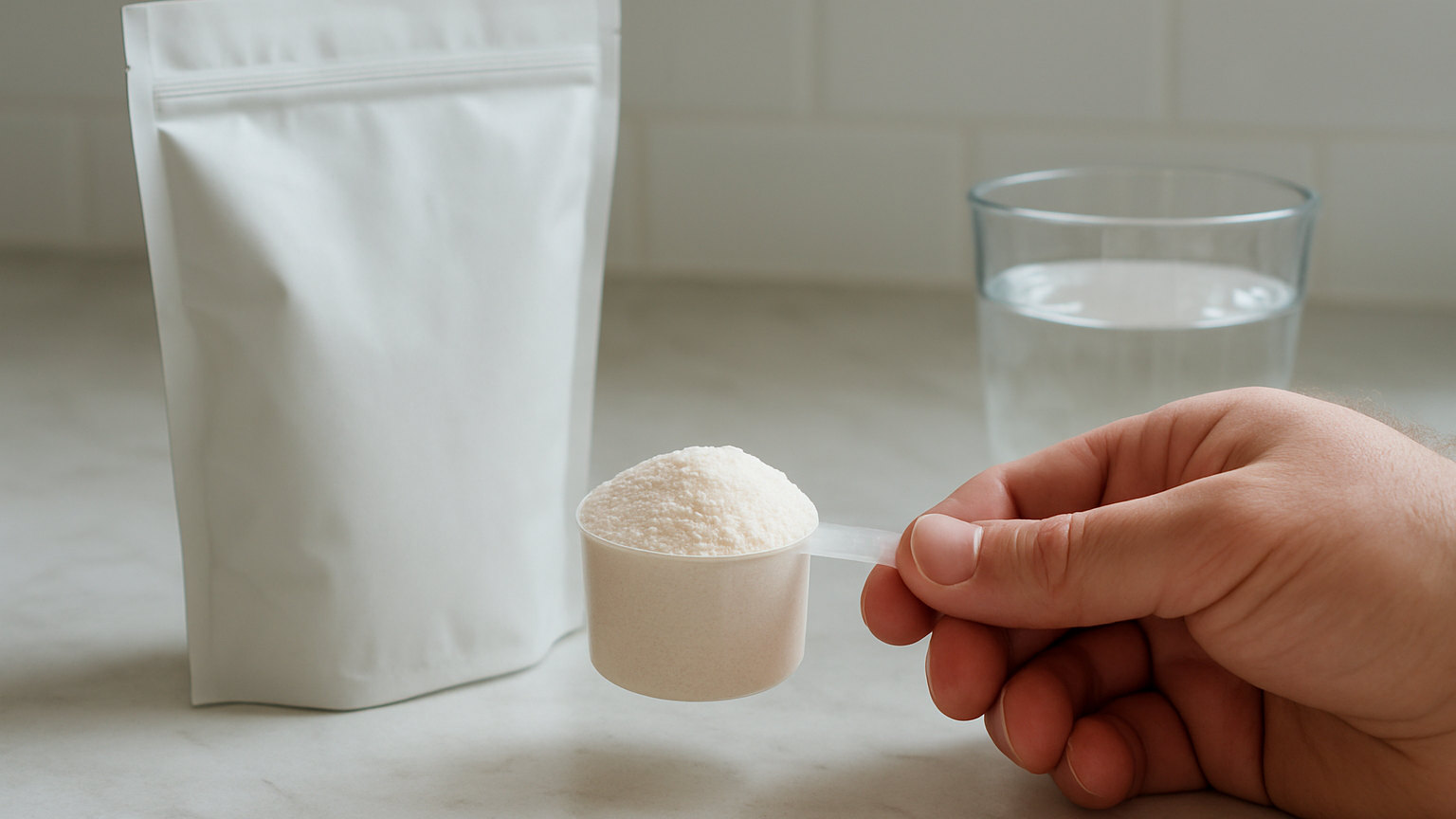
The claim that BCAAs build muscle rests on leucine triggering muscle protein synthesis, which it genuinely does. The problem is what happens next, and it explains why BCAAs alone underperform.
What does building muscle protein require?
All twenty amino acids, of which nine are essential and must come from the diet.
Muscle protein has a specific amino acid composition, and building it requires all the components in appropriate proportions.
Supplying three of the nine essentials provides the signal and not the materials, which is like turning on a production line without delivering the parts.
What does the research show?
A study comparing BCAA ingestion after resistance exercise with placebo found BCAAs increased muscle protein synthesis by around 22 per cent.
That sounds encouraging until compared with whole protein. The same researchers noted the response was roughly half what an equivalent dose of whey produces.
Reviews have concluded that BCAAs alone cannot support increased muscle protein synthesis in the way complete protein can.
Where do the missing amino acids come from?
From the bodys own protein breakdown, which is the crux of the problem. To supply the other six essentials, the body must break down existing protein.
Some researchers have argued this makes BCAA-only supplementation potentially counterproductive, since it may increase breakdown to supply what is missing.
Whether this happens meaningfully in practice is debated, and it explains why the synthesis response is limited.
Does more leucine help?
Beyond the threshold of roughly two to three grams, no. The signal is already maximal, and adding more does not compensate for missing amino acids.
This is why high leucine ratio products such as 8 to 1 to 1 have no advantage, and may be worse by supplying less isoleucine and valine.
What works better?
- Whey protein, which supplies all nine essentials plus abundant leucine
- Any complete protein food, including meat, eggs, fish and dairy
- Essential amino acid supplements, which contain all nine
- Soy or a blended plant protein for those avoiding dairy
Do the trials support BCAAs for muscle?
Longer term studies examining BCAA supplementation and muscle mass in people eating adequate protein have generally found no benefit over the protein alone.
Where positive findings exist, they tend to be in populations with inadequate protein intake, where any amino acid addition helps.
Why does the belief persist?
Because leucine genuinely triggers synthesis, which is a real and demonstrable mechanism. The marketing stops there rather than following the process to completion.
What is the summary?
BCAAs provide a signal without the substrate. Complete protein provides both, usually for less money.
This article is general information and not medical advice.
Does this apply to leucine alone?
The same reasoning applies more strongly. Studies giving leucine alone have found smaller synthesis responses than complete protein at equivalent doses.
Adding leucine to a protein feeding that already meets the threshold does not appear to add anything either.
What about older adults?
Older muscle shows a blunted response to protein, and higher leucine content has been explored as a way to overcome this.
Even here, the research generally supports higher total protein or leucine enriched complete protein rather than BCAAs alone.
What is the practical conclusion?
If you want the leucine signal to produce muscle, supply the other eight essentials alongside it. Whey or any complete protein does this by default.
Why does this matter practically?
Because people substitute BCAAs for protein rather than adding them to it, believing the supplement covers the same ground.
Someone drinking BCAAs during training instead of eating a protein meal has made their situation worse rather than better.
The supplement is not harmful; the substitution is.
What about the studies showing a response?
They generally compared BCAAs against placebo rather than against protein, which answers a different question.
Showing that BCAAs beat nothing is not the same as showing they beat the alternative, and the alternative is usually cheaper.
Understanding the distinction between a signal and a substrate resolves most of the confusion in this area.