Krill oil is marketed as a premium alternative to fish oil, based on a genuine structural difference. Whether that difference justifies the price is a separate question.
What is the difference?
In fish oil, EPA and DHA are attached to triglycerides or converted to ethyl esters during processing.
In krill oil, a substantial proportion is bound to phospholipids instead, which is the form found in cell membranes.
Phospholipid bound omega 3 may be absorbed somewhat more efficiently, and it is more water dispersible, which is the basis for the absorption claims.
Does it absorb better?
Some studies have found higher blood levels from krill oil than from an equivalent amount of fish oil EPA and DHA.
Other studies have found little difference. Reviews generally describe the evidence as suggestive rather than conclusive.
Even where an absorption advantage exists, it needs to be large enough to offset a substantially lower dose per capsule.
How much omega 3 does it contain?
Considerably less than concentrated fish oil. A typical krill capsule might supply 60 to 150 milligrams of combined EPA and DHA.
A concentrated fish oil capsule can supply several hundred milligrams or more.
Reaching a meaningful daily intake from krill therefore requires more capsules at higher unit cost.
What about astaxanthin?
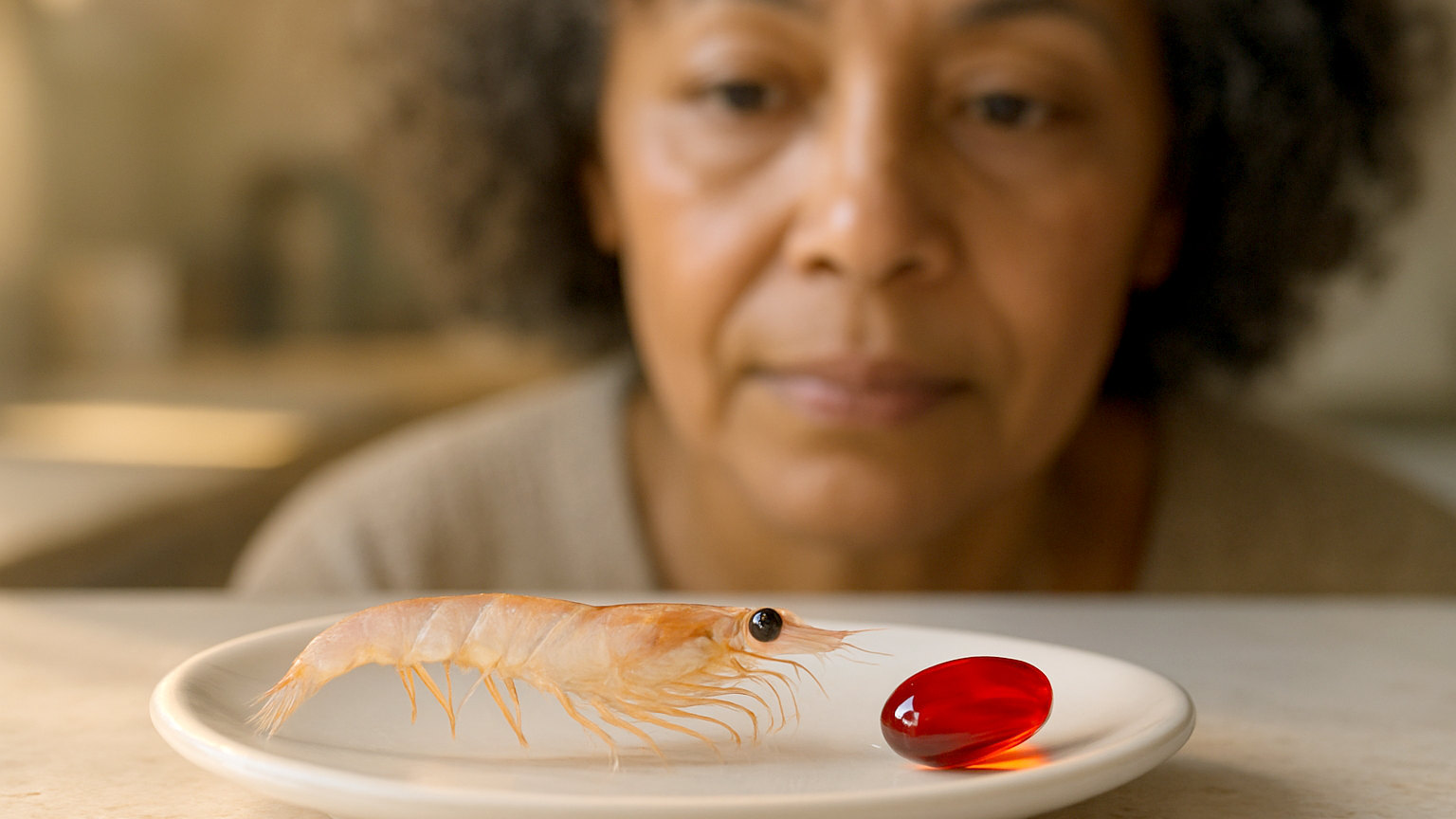
Krill oil naturally contains astaxanthin, a red carotenoid antioxidant that gives it its colour.
It helps protect the oil from oxidation, which is a genuine practical advantage given how readily omega 3 oxidises.
The amounts are small relative to doses used in astaxanthin research, so the health claims attached to it are overstated.
How does the cost compare?
- Krill oil typically costs several times more per gram of EPA and DHA than fish oil
- The absorption advantage, if real, is modest rather than several-fold
- Algae oil is also expensive but supplies more per capsule
- Comparing on cost per gram of EPA and DHA is the useful calculation
Are there other advantages?
Many users report less fishy repeat than with fish oil, which is a genuine practical benefit for some.
Krill are low in the food chain, so they accumulate fewer contaminants than larger fish.
What about sustainability?
Antarctic krill are central to the Southern Ocean food web, supporting whales, seals, penguins and fish.
The fishery is managed and catch limits exist, and concerns remain about localised depletion and effects on dependent species.
What is the summary?
A real structural difference, a modest and uncertain absorption advantage, much less omega 3 per capsule and a much higher price. For most people, fish oil or algae oil is better value.
This article is general information and not medical advice.
What about the environmental question?
Fish oil production also draws on wild stocks, so the sustainability comparison is not straightforward in either direction.
Algae oil is the option that avoids wild harvesting entirely, which is worth knowing if this is a priority for you.
Who might still prefer it?
People who find fish oil causes reflux or aftertaste and have not got on with alternatives.
Anyone taking a low dose for general purposes rather than a therapeutic amount, where the capsule count matters less.
What is the summary?
A genuine structural difference, an uncertain and modest absorption advantage, far less omega 3 per capsule and a considerably higher price.
For most people, fish oil or algae oil delivers more for less.
What should you compare?
Cost per gram of combined EPA and DHA, calculated across the whole bottle. That single figure usually settles the question quickly.
Marketing about superior forms rarely survives that calculation.
What about the astaxanthin claims?
The amounts in krill oil are small compared with the doses used in astaxanthin research, so health claims attached to it are not well supported.
Its practical value is in protecting the oil from oxidation rather than in any effect on you.
For most people the choice comes down to fish oil for value or algae oil for dietary reasons, with krill a distant third.