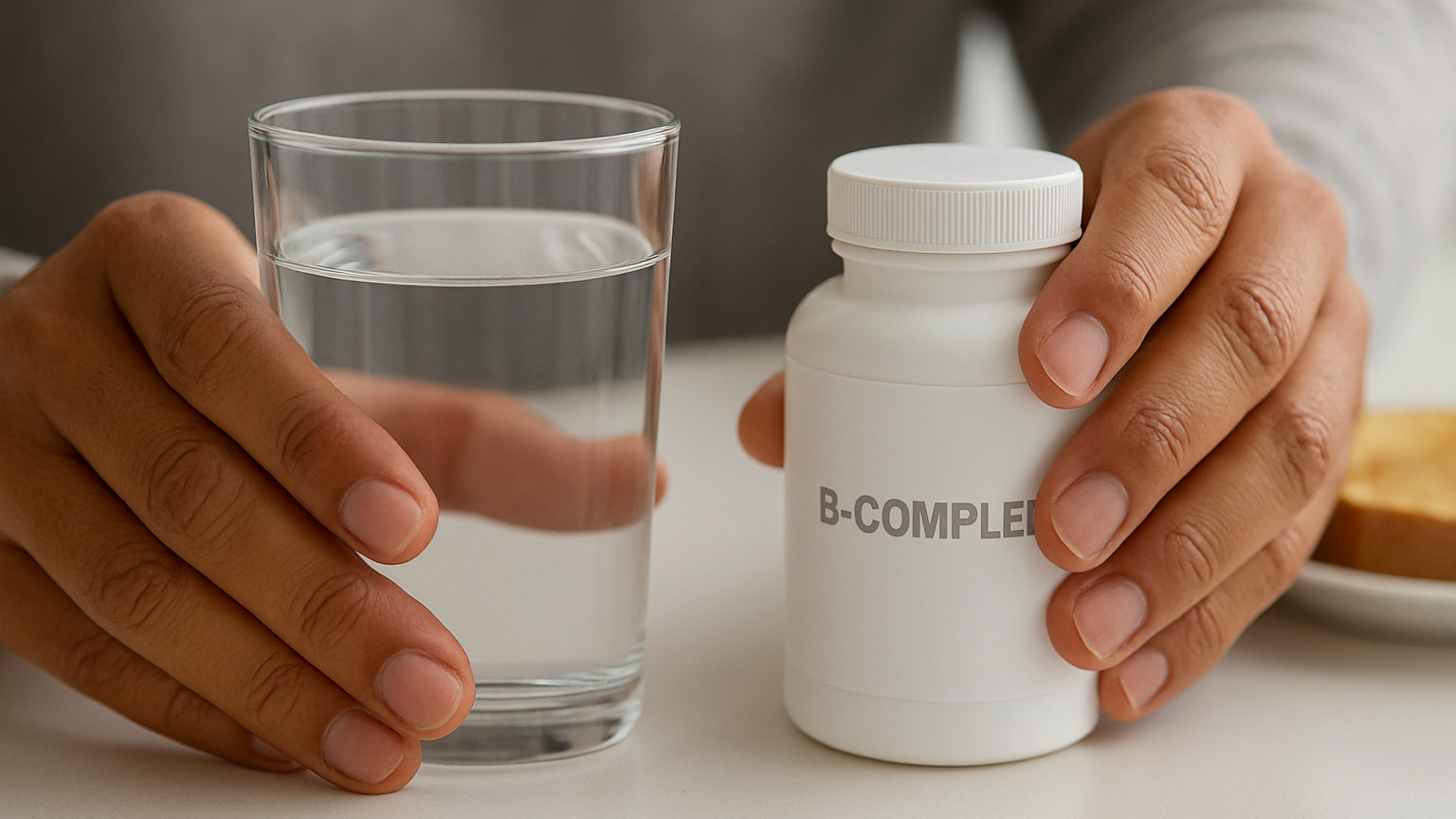
Vitamin B12 has no tolerable upper intake level set by any major body, because no consistent pattern of harm has been demonstrated even at doses hundreds of times the requirement. It is water soluble, absorption is capped, and the kidneys excrete what is not needed. That does not mean taking large amounts is a good idea.
Why is it so well tolerated?
Two mechanisms limit how much actually enters the body. Absorption through intrinsic factor saturates at roughly 1.5 to 2 micrograms per meal, and only around one per cent of the remainder crosses by passive diffusion.
Of a 1000 microgram tablet, therefore, the great majority is never absorbed. What is absorbed and not required is filtered by the kidneys and excreted.
High dose B12 mostly produces expensive urine. That is the practical reality behind the safety profile.
Are there any reported side effects?
They are uncommon and generally mild. Occasional reports include nausea, headache, diarrhoea and a sensation of tingling shortly after injections.
Acne and rosacea like eruptions have been described with high dose B12, particularly after injections, and there is a plausible mechanism involving effects on skin bacteria. It resolves when the supplement stops.
Allergic reactions to B12 injections occur rarely and are usually attributed to preservatives in the preparation rather than to B12 itself. They are a reason to report the reaction rather than to avoid treatment, since alternative preparations exist.
What is the real drawback of high doses?
Diagnostic rather than toxic. Taking B12 raises serum levels quickly, which means that if you are later tested, the result will look normal regardless of whether your absorption is working.
Someone with undiagnosed pernicious anaemia taking a high dose supplement may have a reassuring blood test while the underlying autoimmune condition goes unrecognised. If the supplement is stopped, deficiency returns.
For this reason it is worth testing before starting a supplement if you suspect deficiency, and telling your GP exactly what you take if a test is being arranged. The point is not that the supplement is harmful but that it hides the information the test was meant to provide.
What do high B12 results mean?
A raised serum B12 in someone not supplementing is worth investigating rather than ignoring, which surprises people who assume high is good.
Elevated levels can reflect liver disease, kidney disease, some blood disorders including myeloproliferative conditions, and occasionally solid tumours. The mechanism involves altered production of the proteins that carry B12.
This is not a reason for alarm about a high result while taking supplements, which is expected. It is a reason not to dismiss an unexplained one.
Are there unresolved concerns?
- Observational studies have linked very high B12 supplementation to increased lung cancer risk in some analyses, particularly in men who smoke
- Some cohort data has associated high serum B12 with higher mortality, though reverse causation is a strong candidate explanation
- People with Lebers hereditary optic neuropathy are advised to avoid cyanocobalamin specifically
- People with kidney failure may accumulate the cyanide component of cyanocobalamin, so alternative forms are generally preferred
The observational findings are not established as causal, and they are a reasonable argument against taking far more than you need on the assumption that it cannot possibly matter.
What dose makes sense?
For general supplementation, around 10 micrograms daily covers requirement comfortably. Weekly dosing of roughly 2000 micrograms is an established alternative relying on passive diffusion.
Higher doses have a place in treating confirmed deficiency and in people with absorption problems, where 1000 to 2000 micrograms daily is used specifically because so little is absorbed.
Outside those situations there is nothing measurable to gain from the larger tablet, and the modest dose avoids the diagnostic complications entirely while costing less. That combination makes moderation the straightforward choice rather than a cautious one.
This article is general information and not medical advice. Ask a pharmacist if you take prescribed medicine or have kidney or liver problems.