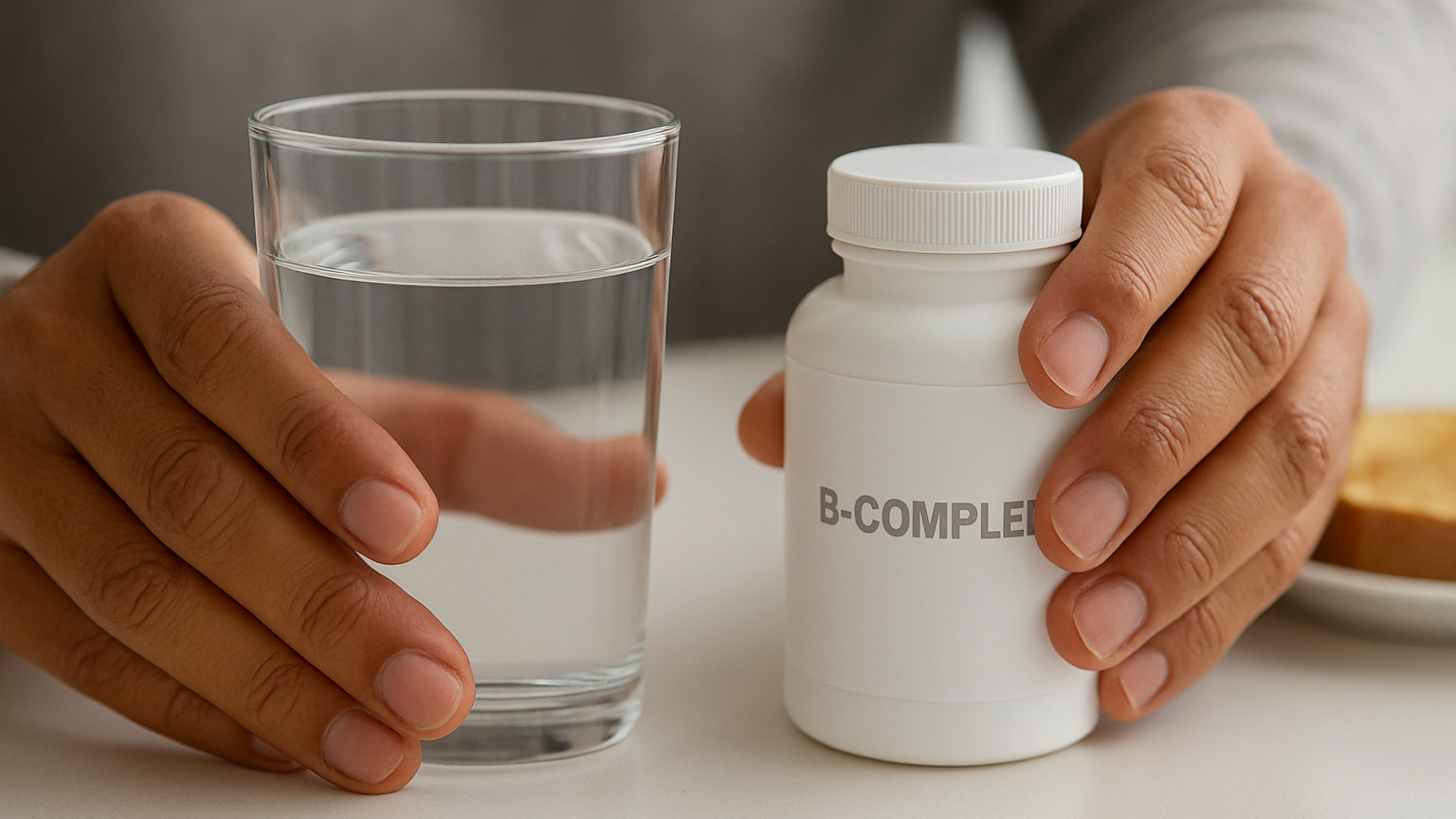
Vitamin B12 is unusual among supplements in having a group of people for whom taking it is not optional. It is found almost exclusively in animal foods, and absorbing it depends on a multi step process that fails reasonably often. For everyone outside those groups, a supplement adds very little.
Why is B12 different from other vitamins?
Two things make it a special case. The first is its source. B12 is produced by bacteria, not by plants or animals, and it accumulates in animal tissue through the food chain. Meat, fish, eggs and dairy contain it. Plant foods, with narrow exceptions, do not.
The second is absorption. B12 must bind to a protein called intrinsic factor, produced by cells in the stomach lining, and that complex is absorbed at a specific site in the last part of the small intestine. Stomach acid is needed first to release B12 from food protein.
That chain has several points of failure. Low stomach acid, autoimmune damage to the stomach lining, surgery affecting the stomach or ileum, and inflammatory bowel disease can each break it, regardless of how much B12 you eat.
Who genuinely needs to supplement?
- Vegans and anyone eating no animal products, where dietary supply is effectively zero
- Vegetarians with low dairy and egg intake, who are frequently marginal rather than sufficient
- Adults over roughly 50, in whom reduced stomach acid impairs release of B12 from food
- People taking metformin long term, which reduces B12 absorption measurably
- People on long term proton pump inhibitors or other acid reducing medicines
- Anyone who has had gastric surgery, bariatric surgery or ileal resection
- People with pernicious anaemia, coeliac disease or Crohns disease
- Anyone who uses nitrous oxide recreationally, which inactivates B12 directly
Pregnancy and breastfeeding on a plant based diet also belong here, because infant stores depend on maternal status and deficiency in a breastfed infant can cause serious neurological harm.
Why does age matter so much?
Atrophic gastritis, a thinning of the stomach lining with reduced acid production, becomes progressively more common with age and is estimated to affect a substantial minority of older adults.
Without adequate acid, B12 bound to food protein is not released and cannot be absorbed. The important detail is that supplemental B12 is not protein bound, so it is absorbed perfectly well by people who cannot absorb it from a meal.
This is why guidance in several countries suggests older adults obtain B12 from supplements or fortified foods rather than relying on diet alone.
Who does not need one?
Someone eating meat, fish, eggs or dairy regularly, under about 50, not on the medicines listed above and without a gut condition is very unlikely to be short of B12.
Body stores are large relative to daily requirement, with the liver holding enough to last several years. This is why deficiency from diet alone develops slowly and why a healthy omnivore has substantial reserve.
Adding B12 in that situation does nothing useful. Excess is excreted, and the fatigue that prompts many purchases is far more often explained by something else.
What dose is appropriate?
The UK reference intake is 1.5 micrograms a day, which sounds trivially small and is misleading as a supplement target. Only a small proportion of a large oral dose is absorbed once intrinsic factor is saturated.
Common supplement recommendations for vegans are around 10 micrograms daily, or roughly 2000 micrograms once weekly, both of which rely on the small percentage absorbed by passive diffusion at high doses.
Confirmed deficiency, particularly from pernicious anaemia, is treated with injections or high dose oral therapy under medical supervision rather than with a shop bought tablet.
What should you do if unsure?
Ask a GP for a blood test rather than guessing, especially if you have symptoms such as unusual fatigue, pins and needles, or memory problems. B12 deficiency can cause nerve damage that becomes permanent if left untreated for long enough.
If you are vegan and asymptomatic, simply take a supplement. It is inexpensive, safe and removes the question entirely.
This article is general information and not medical advice.